

Cryptogram · Cryptoquote Game
Razzle Puzzles
I enjoy word games that give me something to think about without demanding a long session, and Cryptogram · Cryptoquote Game fits that space well. It is a free word game from Razzle Puzzles built around decoding quotations: each letter in the puzzle stands for another letter, and I work out the substitution until the hidden sentence becomes readable. The idea is familiar, but the appeal comes from the small decisions between an obvious opening guess and the final stubborn word.
After spending time with it, I see it as a quiet puzzle companion rather than a broad language-learning tool or a competitive social game. It suits a coffee break, a short commute when I am settled somewhere, or an evening when I want to exercise pattern recognition without opening a demanding action game. The Everyone age rating also makes its presentation approachable for a wide audience, although the difficulty of a quotation can still vary considerably depending on vocabulary and familiarity with expressions.
How the quotation-solving loop feels in practice
The basic loop is easy to understand. I look at a quotation represented through coded letters, search for likely short words, notice repeated patterns, and gradually build a relationship between the cipher symbols and the alphabet. A repeated three-letter pattern might suggest a common word, while a longer repeated structure can reveal an entire phrase once one or two letters are known.
What makes this more satisfying than a simple anagram is that every correct deduction affects several places at once. If I decide that one symbol represents a particular letter, that choice can clarify a word near the beginning and expose a partial word near the end. The puzzle therefore rewards cautious reasoning. Guessing quickly may produce a tempting phrase, but checking whether the same substitution works consistently is where the real challenge lies.
I found the most useful habit was to begin with structure rather than meaning. Instead of trying to recognize the quotation immediately, I first inspect one-letter words, repeated symbols, common endings, and words that appear more than once. This prevents me from forcing a familiar saying onto an arrangement that does not actually support it. Once enough letters are in place, the wording usually starts to guide the remaining deductions.
Related News






That approach also explains why the game can feel different from one puzzle to the next. A quotation with several common short words may open quickly, while one built around unusual names, formal language, or less familiar phrasing can remain resistant even when most of the cipher is visible. I appreciate that variation, but it means the experience is not perfectly even. Some sessions feel like a clean chain of discoveries; others become a slow search for the one missing assumption.
A useful routine for difficult puzzles
When I reach a dead end, I stop treating every unknown symbol as equally important. I mark the words with repeated patterns and compare them with ordinary English word shapes. For example, a word with the same first and last coded letter may point toward a recognizable structure, while a repeated two-letter ending can narrow the possibilities. I then revisit earlier guesses and ask whether they create contradictions elsewhere.
This is more effective than repeatedly tapping random letters. It also keeps the game from becoming a test of luck. The strongest moments come when I solve a quotation because the pattern finally makes sense, not because I happened to try a letter that worked. Players who enjoy logic grids, crosswords, or cryptic-style deduction will probably understand this rhythm quickly.
Gallery
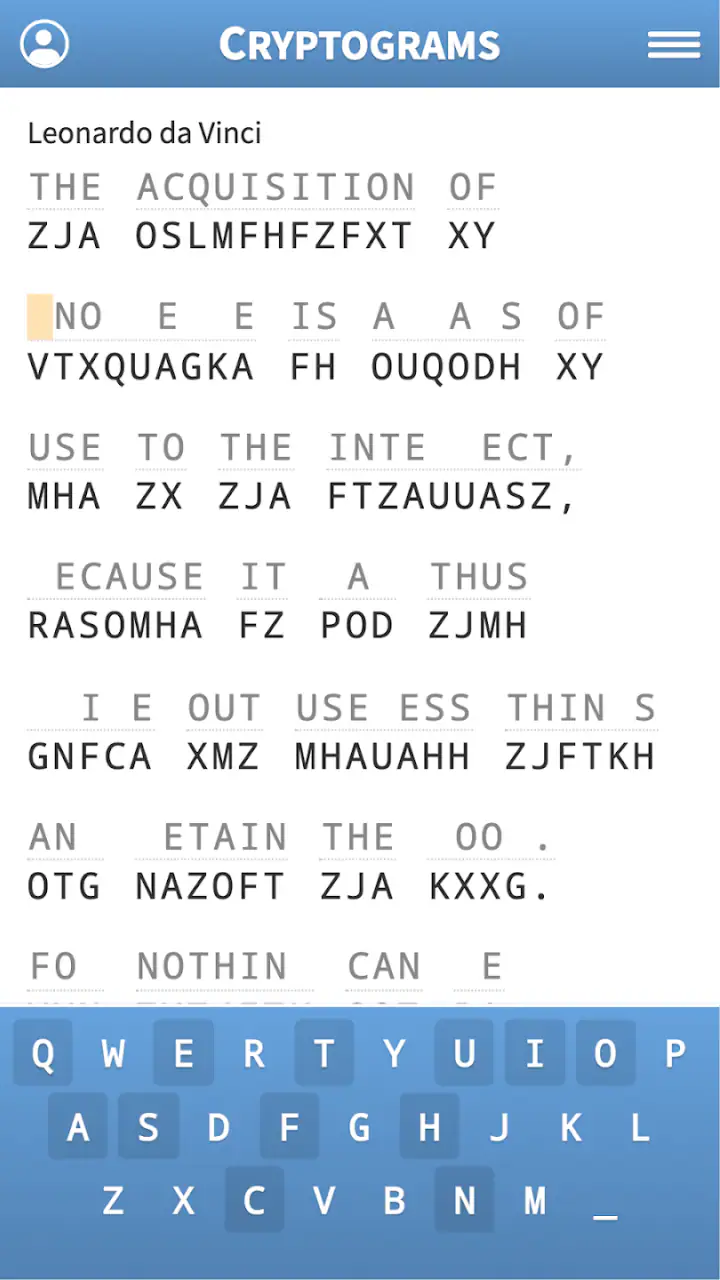
There is a practical reason to solve in stages as well. If I fill in a promising word and immediately move on, I can overlook the fact that the same cipher letter appears in another word. Checking the whole quotation after each meaningful deduction reduces careless errors. I treat the puzzle like a small worksheet: identify a clue, test it globally, and only then commit to the next step.
Where progress feels rewarding and where pressure appears
The game’s progress is primarily intellectual. I am not playing to build a character, collect equipment, or unlock a story campaign. The reward is the moment a scattered set of symbols turns into a complete thought. That makes it easy to return after a break because I can resume the same mental problem without remembering a complicated system.
At the same time, this kind of progress can feel less tangible than progression in a larger puzzle collection. If I need visible goals, elaborate stages, or a strong sense of advancement, a standard word-game app with themed packs or a daily challenge structure may feel more motivating. Cryptogram works best when solving itself is enough of a reward.
I also think the absence of action pressure is one of its strengths. I can take time to inspect a phrase rather than racing a timer or worrying about an opponent making a better move. That makes it suitable for relaxed play and for people who dislike games that punish a thoughtful pause. The trade-off is that players who want excitement, urgency, or a constant stream of new mechanics may find the format restrained.
My everyday use case is simple: I open it when I have a few quiet minutes and want something more engaging than scrolling. I might solve part of a quotation, put the phone down, and return later with a fresh perspective. Because the central task is self-contained, the game does not require me to prepare a session or remember a complicated objective. That makes it more practical than a long-form game when my attention is fragmented.
Fairness when the game is free
The game is listed as free, which removes the most obvious barrier to trying it. I can decide whether the substitution-cipher format suits me before committing money. For a word puzzle, that matters: the central question is not whether the concept sounds appealing, but whether I enjoy repeatedly reading patterns, testing hypotheses, and completing quotations.
I am careful not to treat “free” as a promise about every possible aspect of the experience. The purchase details that matter to a player—such as whether there are optional paid items, how interruptions are handled, or whether a paid version changes the experience—should be checked on the current platform page before installation. I would not assume anything beyond the confirmed free listing. That is a more useful way to judge spending fairness than guessing about systems that are not clearly documented.
From a gameplay perspective, the important fairness question is whether the puzzle can be solved through reasoning rather than payment. The core challenge is naturally suited to deduction: repeated patterns, word length, and sentence structure provide the tools. If I use assistance, I regard it as a convenience that reduces the puzzle’s mental work, not as a replacement for understanding the cipher. Players who care about a pure solve can simply approach each quotation slowly and avoid leaning on help.
There is also a difference between fair difficulty and frustrating difficulty. A hard quotation feels fair when the visible pattern offers a path forward, even if that path takes time. It feels less fair when the wording depends on a phrase I do not recognize or on a word I would never reasonably infer from the available letters. That distinction is subjective, but it is worth remembering before blaming yourself for a puzzle that may simply be a poor fit for your vocabulary.
How it compares with familiar word-game alternatives
Compared with a crossword, this game gives me fewer independent clues and more repetition-based deduction. A crossword lets me use definitions, general knowledge, and crossing answers; here, one correct letter can unlock several locations, but the initial clue is the shape of the words and the quotation itself. I prefer the cryptogram format when I want a single connected problem rather than a grid with many separate entries.
Compared with an anagram game, it feels less dependent on quickly spotting letter combinations. Anagrams reward rearrangement and vocabulary recall, while this game asks me to maintain a consistent mapping between symbols and letters. That makes it a better choice for players who enjoy logic and sentence structure, but a less natural choice for someone who wants rapid rounds with an obvious answer pool.
Compared with a daily word challenge, the experience is less about maintaining a public routine and more about solving at my own pace. Someone who enjoys comparing results, protecting a streak, or discussing one shared puzzle may prefer a daily format. Someone who wants to open a quotation whenever the mood strikes may appreciate the looser rhythm here.
It also differs from a conventional quote browser. I am not simply reading an inspirational sentence; I earn the sentence by reconstructing it. That extra effort can make a familiar line more memorable, but it also means the game is not ideal when I only want quick relaxation or passive reading.
Who will enjoy it, and who should skip it
I would recommend it to people who like wordplay but do not necessarily want a timed contest. It is especially suitable for players who enjoy spotting patterns, checking logical consistency, and working through a problem that becomes clearer in stages. Readers who often pause over quotations or enjoy noticing how language is assembled may find the format naturally satisfying.
I would be more cautious about recommending it to someone who wants a large range of puzzle types in one app. The central appeal is focused, and focus can become repetition if the substitution format does not hold your attention. I would also suggest looking elsewhere if you need strong competitive features, a rich narrative, or a highly visible progression system. This is a decoding game first, and its value depends on whether that single activity remains enjoyable.
Language comfort matters too. Since the solution is an English quotation, players who are still building English vocabulary may face a double challenge: decoding the letters and understanding the completed sentence. That can be rewarding as practice, but it may also make some puzzles feel inaccessible. A crossword with definitions, a vocabulary trainer, or a game in the player’s strongest language could be a better starting point in that situation.
Practical details before installing
Razzle Puzzles has kept this title in the word-game space for a long time; it was released on August 14, 2014. The current version is 1.90, and it requires Android 6.0 or later. Those details make compatibility worth checking before installation, especially on an older device or a phone that has not been updated in some time.
The game has an average rating of 4.5 from around twelve thousand ratings, with roughly three thousand seven hundred written reviews. It has also passed five hundred thousand installs. I read those figures as evidence that the format has found a substantial audience, not as a guarantee that every player will enjoy it. A focused cryptogram can be deeply satisfying for one person and repetitive for another.
The age classification is Everyone, and the listed price is free. Those two points make it easy to consider for casual household use, but I would still make installation decisions based on the current store screen and the device requirements. In particular, I would check the live listing for the exact experience offered on my platform rather than assuming that an older release behaves exactly like a newer puzzle app.
One small but important expectation-setting tip is to treat the game as a thinking tool, not as a source of guaranteed quotation knowledge. Recognizing a line can help, but memorizing famous sayings is not required to enjoy the deduction. Conversely, recognizing a quotation can make a puzzle much easier, so players who want maximum challenge should try to solve the letter structure before searching their memory for the phrase.
What I would like to know before spending time with it
The first question I would ask is whether it works for short sessions. In my experience with the format, yes: a quotation can be approached in small steps, and the central state is easy to understand when I return. The more important question is whether the player enjoys unresolved puzzles. If an incomplete sentence feels irritating rather than inviting, the same flexibility may not help.
The second question is whether a beginner can start without already knowing cryptograms. The rules are straightforward enough to learn through the first few puzzles, and the visual relationship between repeated symbols and repeated letters provides a natural lesson. Still, I would expect the first genuinely difficult quotation to require patience. Learning the method is quick; becoming good at choosing the most informative next letter takes practice.
Another reasonable concern is whether the game is useful offline. I would not make a definite claim about offline behavior without checking the current platform listing and testing the installed build under the conditions that matter to me. If I specifically need a word game for flights, weak-signal areas, or a data-limited plan, I would verify that point before relying on it.
Players may also wonder whether the content stays fresh. The confirmed description establishes the cryptoquote concept, but it does not justify promises about a particular content schedule or an endless supply of new material. My advice is to judge the game by how much enjoyment you get from its core quotation-solving loop, not by expecting the kind of rotating live service that some daily puzzle apps provide.
My trust verdict after weighing the trade-offs
My overall view is positive, with a clear condition: you need to like decoding quotations for its own sake. The game is easy to understand, inexpensive to try because it is free, and thoughtful enough to reward a methodical player. I like that the challenge comes from connecting evidence across a sentence rather than from frantic tapping or complicated menus.
The fairest way to approach it is to judge the puzzle, not the promise of a larger game system. Each completed quotation should feel like a small reasoning victory. If that is what you want from a mobile word game, this is a sensible download to consider. If you want social competition, varied mechanics, or a deep progression track, the usual crossword, anagram, or daily-challenge alternatives may serve you better.
Razzle Puzzles’ Cryptogram · Cryptoquote Game is therefore best for quiet, self-directed play. I would install it when I wanted a compact mental exercise that could fit around ordinary life, while keeping my expectations realistic about its focused design. The lack of spectacle is not a weakness here; it is the reason the game can be calming. But that same narrow focus means the final recommendation depends almost entirely on one question: do you enjoy turning a wall of coded letters into a sentence one careful deduction at a time?
FAQs for Cryptogram · Cryptoquote Game
What is Cryptogram · Cryptoquote Game?
Cryptogram · Cryptoquote Game is a word puzzle app based on classic cryptograms. Each puzzle presents a quotation in which the original letters have been replaced with symbols or other letters. Your goal is to decode the message by identifying patterns, testing possible words, and gradually revealing the complete quote. It combines logical deduction, vocabulary, and general knowledge in short, self-contained challenges.
How do you play Cryptogram · Cryptoquote Game?
To play, select a puzzle and examine the encrypted quotation for repeated symbols, short words, and familiar letter combinations. Tap a symbol or letter position, then enter the character you believe belongs there. Correct guesses reveal more of the quote, while incorrect guesses can be changed as you refine your solution. The game is designed to be approachable, but harder puzzles may require patience and careful pattern analysis.
Is Cryptogram · Cryptoquote Game suitable for beginners?
Yes. Beginners can start with easier quotations and learn the basic substitution-cipher mechanics without needing specialist knowledge. The interface generally makes it simple to enter, replace, and review guesses, while hints or assistance may help when a puzzle becomes difficult. However, the challenge increases as quotes become longer or use less obvious vocabulary, so the app can remain engaging for experienced word-game players too.
Does Cryptogram · Cryptoquote Game require an internet connection?
Many cryptogram apps allow at least some puzzles to be played offline after installation, but the exact availability of features can depend on the app version and device. Online access may be needed for advertisements, downloading additional content, synchronizing progress, or other connected services. If offline play is important to you, check the current store description and test the app after temporarily disabling your connection.
Is Cryptogram · Cryptoquote Game free to download, and does it contain ads or purchases?
The game can generally be downloaded without an upfront purchase, but free versions may include advertising or optional in-app purchases. Depending on the edition, payments may remove ads, provide hints, unlock extra content, or support other convenience features. Before downloading, review the Google Play or App Store listing for the latest pricing, subscription details, age rating, and privacy information, since these terms can change.
Pros
- Large quote library keeps the daily puzzles feeling fresh.
- Hints help you progress without revealing the full solution.
- Simple controls make it comfortable to play one-handed.
- Works well for short sessions during commutes or breaks.
- Solving quotes can reinforce spelling and vocabulary skills.
Cons
- Some puzzles may rely on quotes unfamiliar to certain players.
- Difficulty can vary noticeably between consecutive puzzles.
- Frequent hint use may reduce the challenge and satisfaction.
- Ads may interrupt the experience
- depending on the app version.
- Limited appeal if you prefer word games without literary quotes.


